
Progression: A powerful training heuristic
Strategies for creating space to hit the optimal training doses in both the short and long term.

In recent pieces we discussed some common errors seen in the build up to championship performances. One key error I have seen and made myself numerous times is too much intensity too soon in the training plan. This becomes unsustainable and can result in the need to substitute in more rest and recovery than planned, and ultimately can cause a drop in chronic load as a result. The principle here is the right load at the right time. It’s an easy one to get carried away with, in the search for confidence that plagues many athletes and coaches.
Another way this principle manifests itself is described in the second piece, “Don’t be a January Champion”, in which we discuss the opportunity costs which can affect the accumulation of load over time (consistency). Next was the over-estimation of the amount of intensity needed in both the short term and long term, and the concept of saving your ‘full gas’ efforts for the days when it really matters. Many times I’ve seen athletes arrive on race day and be unable to deliver a full effort, as a result of the number of times they pushed themselves to the limit in the build up.
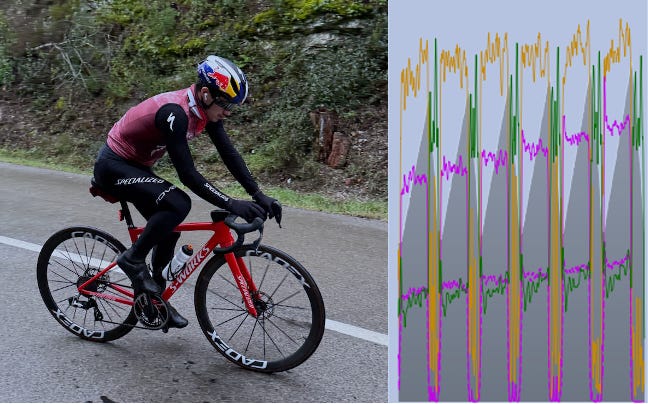
A powerful solution to the problems of timing and dose of intensity, is the concept of progression. In a recent onboarding of a new athlete, they remarked that typically they had focused on just one intensity / zone during a session in their previous training model. For example a simple threshold session, or vO2 max session, where all the intervals were of the same intensity and type. Whereas the sessions we were performing were of the type where the intensity steps up over the course of the session. For e.g. we were doing hill repeats where the goal was that each repetition was slightly higher watts and RPE than the one before.
Progression within training sessions
In terms of training sessions, we do many of our sessions in this format - progression from slower to faster.
There are several reasons why I find these types of sessions highly effective:
It allows the athlete to learn to navigate intensity and RPE on a given day and manage their response to the overall chronic load. The goal is to find the optimal stimulus and session load depending on energy and sensations, as well as objective measures.
Instead of sticking to one range e.g. 280-300W, we might progress from 250-260-270-280-290-300-310, etc, over the course of the session. The amount of progression an athlete might do in a session like this can be sometimes more, or bigger steps, but also can be less in terms of peak power/speed or the size of the steps. The range can also be higher or lower, depending on how the athlete chooses to manage the session.
Success in a progressive session is a consistent upward trend, which encourages accurate pacing and mind-body connection to set the right starting power and size of the steps. This also reduces the chances of ‘failing’ a session, as there is room to negotiate the execution, vs a tighter or more narrow range that may be too much on a given day otherwise.
This approach takes some learning and development to understand how to navigate to find the optimal load for the day, and creates space to grow and progress week by week. Some athletes struggle without precision of what exactly to do early on in this methodology, however this is a skill that can be learned.
We often follow the principle of extension within a training block, where the duration of intervals gets longer each week, as the intensity remains similar (thereby increasing the session load). As the duration of the intervals extends, the athlete can navigate the outputs according to how they feel and the goals of progression across the series.
This approach also recognises that there is day to day variation in an athlete’s session performance, and that working within a wider range also means that success isn’t always just doing more or higher / faster, but determining what the right load on a given day may be.
This flexibility is a powerful training concept and allows greater consistency and long term progression.
Progression across the season
Progression is also a useful concept to answer the question of ‘where do we go from here?’ This question is often on my mind in building training blocks. What is the volume of intensity / work blocks across the weeks, and how does the progression work from one week to the next.
I try to avoid progression the volume of intensity too quickly. A progress of hill repeats across a block of work might be starting with 3 mins efforts one week, and then going 4,, 5, 6, 8, and finally 10 mins for example. Or starting build runs relatively short, 8-9 mins for example, and growing the steps each week. This way we don’t hit the peak session load too early in the block, which could result in a regression of performance, and the chronic load/fatigue builds each week.
It’s tempting to want to progress the volume of intensity more quickly, as often the sessions feel ‘too small’ (the ego problem again showing itself). But it’s a reminder that the overall load is not just the volume of intensity / work blocks, but of all the frequency and volume that accumulates across both the weeks, and longer blocks of work.
By following these kinds of progressions across a training block, we are creating space to adapt to the load step by step. We also then allow ourselves to hold the load at one level, before moving onwards, or even stopping the progression if we can see the athlete is reaching the ceiling of the particular type of work within that training block.
Hitting session volumes that are too high too early can be more stressful than desired at the early steps in a training block. This can also result in the feeling that there is nowhere to go from there. If an athletes is already nearing the maximum session load early in a training block, they may be then just ’surviving’ the load vs truly adapting and growing stronger and fitter week, by week.
Many athletes get stuck in this training survival mode, and what we see then is an eventual need to make an intervention with rest and recovery to ‘catch-up’. However we try to avoid this happening, as the catch-up breaks consistency and can take longer to get back on track vs more intelligent and wise progressions built into the programming from the first stages.
Progressions over the years
This concept equally applies to multi-year athlete development plans. Depending on the athlete’s background, it can take time to grow the training load tolerance. Choosing the right long term progressions can avoid injury and burn out, the two main causes of athlete’s not achieving their potential, or indeed even stopping sport. The concept of ‘training to train’ from the Long Term Athlete Development model (LTAD) can useful here, along with a healthy dose of patience and perspective. There are no short cuts to long term athlete performance.
The concept in all three phases of session progression, season progressions and long term progression creates space for a more individual approach, that allows for athlete self management and learning, as well as accounting for the day to day variation, to hit the optimal training load to build consistency over time.
Applying this concept requires ego control and long term perspective, on part of both the athlete and the coach, however once learned and applied, can be a powerful training heuristic to achieve the most of an athlete’s potential.
Consistency trumps intensity.
Recent Updates:
Don’t be a January Champion article + Podcast + Youtube video
Championship Reflections article + Podcast + Youtube video
Follow the squad’s new instagram account JFTcrew
How to show your support
Subscribe to the Real Coaching podcast:
Share with someone who might benefit:
Personal Coaching for Triathletes
Coaching - ideal candidates for personal coaching are highly ambitious and experienced athletes who are looking to seek the best possible guidance to improve their performances. Typically those who have gotten stuck, reached a performance plateau, or struggle to escape from injury or underperformances.
Consulting - For those not ready or looking for full 1-1 coaching, a thorough consultation and review of your programming, periodisation or other topics that will help you solve problems and perform better is available.
Coach Mentorship - coaches can receive support, mentorship and guidance from Joel - coaches can benefit from coaching - a ‘second set of eyes’ on your coaching practice.
Email at coaching@joelfilliol.com to inquire or visit joelfilliol.com
“Champions are all around us, all you have to do is train them properly ”
— A. Lydiard

Joel’s current project is his independent elite multi-national triathlon squad #JFTcrew, consisting of Olympic athletes focusing on the World Triathlon Championship Series, through which he has supported athletes to achieve more that 30 World Triathlon Series winning performances, as part of more than 100 World Triathlon Series podiums, and 6 overall World Triathlon Senior Elite World Championships Titles.
Previously Joel served Triathlon Canada as National Senior Coach and Beijing 2008 Olympic Coach, where he guided Canadian Simon Whitfield to the Silver Medal in Beijing, British Triathlon as Head Coach, Federazione Italiana Triathlon in the role of Olympic Performance Director, and Triathlon Australia in the role of Podium Centre Head coach and Olympic Program Head Coach.
Instagram | Facebook Page | LinkedIn | X | Youtube | iTunes Podcast